
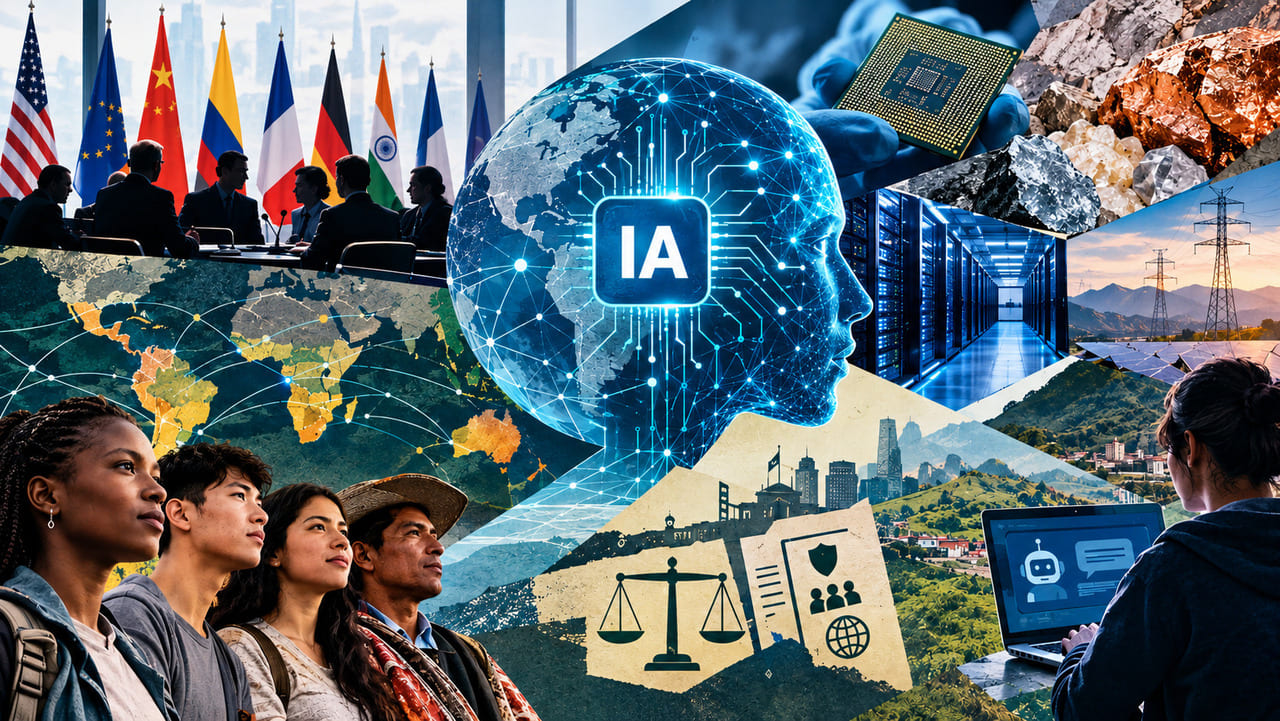
For years, artificial intelligence (AI) was presented as a matter for engineers, laboratories and advanced programming. That image no longer reflects reality. Today, AI is discussed at summits of heads of state, in national security committees, in trade negotiations and in multilateral organizations. What once seemed a technical question has become a question of power.
It is impossible to understand today’s debates on artificial intelligence if we view it merely as a tool. We must see it for what it truly is, a system that reorganizes relations among countries, companies and citizens.
A Socio-Technical Lens
The socio-technical approach, informed by various strands of science and technology studies, starts from a key premise, namely that technology and society are mutually constructed.
A language model does not exist in a vacuum. Behind it lie chips manufactured in just a few places in the world, vast data centers that consume water and electricity, datasets with cultural biases, workers who label information, companies with commercial interests and governments that set the rules.
Viewing AI from this perspective allows us to set aside two assumptions. The first holds that technology is neutral. The second claims that it advances on its own, like a natural force impossible to steer. Neither withstands serious analysis.
The Question of Agency
This is where a concept central to the social sciences comes in, that of agency. By agency we mean the capacity of a human or non-human actor to influence its environment. Applied to artificial intelligence, the concept forces us to ask who really decides. The states that regulate? The corporations that design the systems? The citizens who use them every day?
Building on this definition, some authors argue that automated systems themselves exercise a form of agency, insofar as they filter information, recommend decisions and shape behavior. Without needing to attribute will to machines, the fact remains that AI redistributes agency. It grants greater capacity for action to those who control it and narrows the room of those who merely consume it. That redistribution is, in essence, geopolitical.
The New Geography of Power
The race for artificial intelligence has a material foundation that is often overlooked. Advanced semiconductors, critical minerals, energy and computing capacity have become strategic resources. That is why the major powers resort to export controls, industrial subsidies and technology alliances.
It is not only about selling products, but about securing who will be able to train the most capable models and who will be left behind. In this scenario, sovereignty is no longer measured solely by territory or military strength, but also by access to digital infrastructure. A country without its own computing capacity finds its agency to shape its technological future constrained.
The Battle over the Rules of the Game
Material competition is compounded by normative competition. At least three major models are in tension. One prioritizes risk-based regulation and the protection of fundamental rights. Another relies on market self-regulation and corporate innovation. A third positions the state as the central guide and supervisor of technology.
Each model expresses different political values regarding privacy, freedom of expression and the role of institutions. Whoever succeeds in having its rules adopted as the international standard will extend its influence far beyond its borders. Regulating AI is, at bottom, a way of exporting a worldview.
The Global South between Dependence and Opportunity
Amid this dispute, the countries of Latin America, Africa and much of Asia risk being relegated to a secondary role. They tend to supply data, minerals and largely invisible labor, such as information labeling or content moderation, while importing technologies designed with other priorities and in other languages. This asymmetry limits their agency.
Yet the picture is not settled. Regional cooperation, investment in local talent, the development of models adapted to their own languages and contexts, and active participation in international forums can open up spaces for autonomy. The key lies in moving from being passive citizens to becoming participants with a voice in defining the rules.
To Govern Technology Is to Govern Society
Artificial intelligence is not an external force that descends upon our societies. It is the product of human decisions, economic interests and political projects. That is why the underlying debate is not about what AI can do, but about who retains the capacity to decide over it and for whose benefit.
Defending the agency of societies, of both states and citizens, requires transparency, technological education and spaces for democratic deliberation (although democracy is, in itself, a form of collective agency). If artificial intelligence is power, the urgent question is how to distribute it more fairly.