


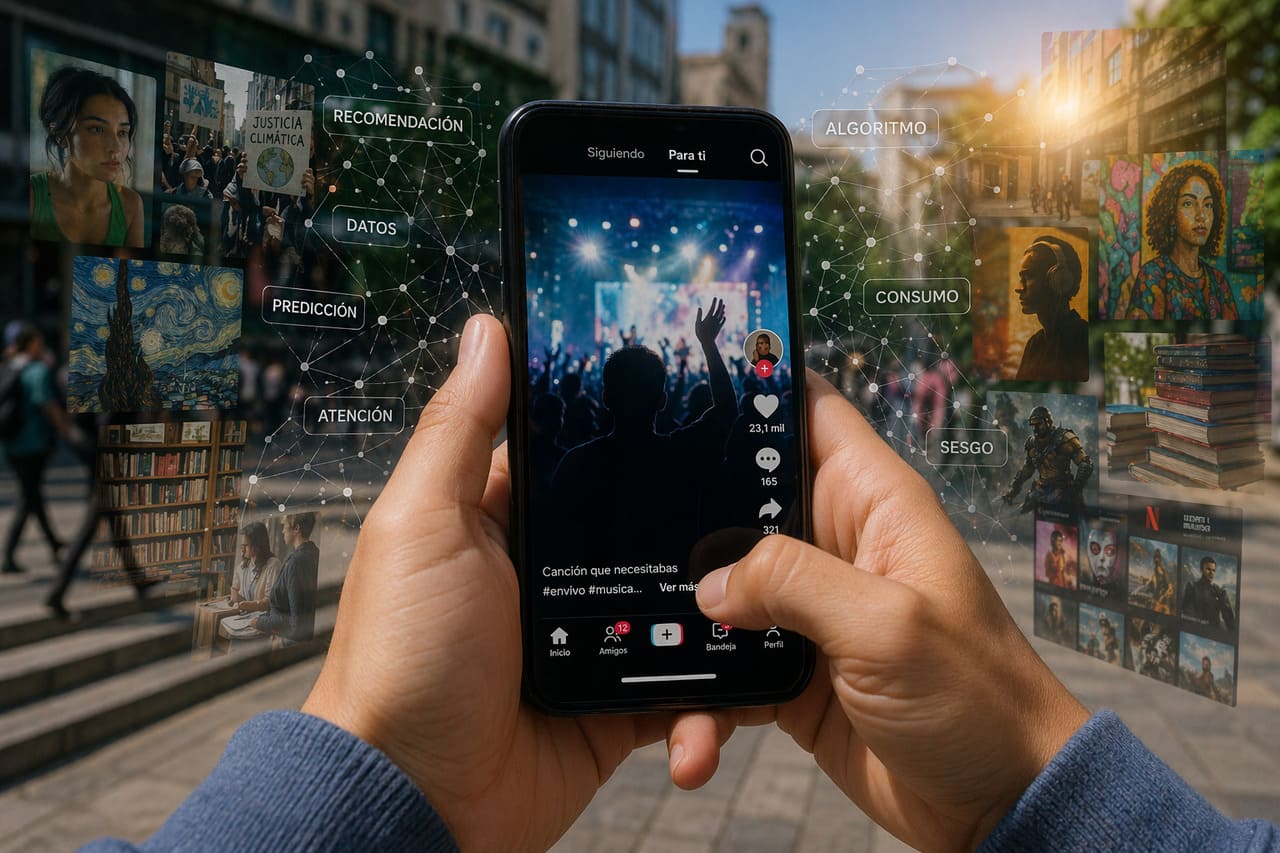
The question of power has never been foreign to culture. Every era has had its mechanisms of symbolic distribution: the medieval church that decided which images could be displayed, the 20th-century publishing industry that determined which texts deserved to be published, and television that for decades set the rhythms of mass cultural consumption. Today, algorithms play that role. With unprecedented efficiency and almost no visibility, computational recommendation systems organize what millions of people read, listen to, watch, and ultimately, think.
This article proposes a critical reading of the algorithm as a cultural device: not a neutral tool at the service of users, but an architecture of power that produces subjects, organizes behaviors, and distributes the visible and the invisible in the contemporary symbolic sphere. To this end, it draws on conceptual frameworks from cultural studies, media sociology, and critical technology theory, incorporating contributions from Michel Foucault, Shoshana Zuboff, Manuel Castells, Taina Bucher, Kate Crawford, José van Dijck, Eli Pariser, Néstor García Canclini, Safiya Umoja Noble, and Jaume Colomer, among others.
The analytical approach is structured in five movements. First, the Foucauldian concept of the dispositif is examined as a theoretical entry point for understanding algorithms beyond their technical dimension. Next, the macroeconomic context of surveillance capitalism in which these algorithms operate is analyzed, along with their relationship to the production of taste and cultural preferences. Third, the effects of algorithmic personalization on audience formation and the fragmentation of collective cultural experience are addressed. Then, the dimension of structural bias and symbolic inequality reproduced by these systems is examined. Finally, the article concludes with a reflection on the possibilities of sovereignty and critical agency in the face of algorithmic mediation.
The hypothesis that underpins this text is that algorithms do not reflect pre-existing preferences: they produce them. And that this production is not politically innocent. Understanding this is the first step to challenging it.
From technical instruction to social apparatus
There’s a scene that repeats itself millions of times a day and has become completely normalized: someone opens a streaming platform , a social network, or a search engine, and before they can even formulate a wish or a question, the system has already decided what they’ll see first. This anticipation—silent, invisible, and efficient—is the central political operation of algorithms in contemporary life. It’s not a neutral technical decision. It’s a form of power.
Examining algorithms from the perspectives of social sciences and cultural studies involves shifting the question. It is not enough to investigate how a recommendation system works; it is necessary to ask for whom it works, what values it incorporates, what hierarchies it reproduces, and what ways of life it makes possible or invisible.
The concept of the dispositif, developed by Michel Foucault (1977) in the context of power analysis, offers a productive approach to thinking about algorithms. A dispositif is not simply a tool: it is a heterogeneous set of discourses, institutions, practices, and techniques that produces subjects, organizes behaviors, and distributes the visible and the invisible.
In this sense, Taina Bucher (2018) has argued that algorithms operate under a conditional logic that is not passive but actively performative: they not only respond to user preferences but also contribute to producing them. The cause-and-effect structure underlying any recommendation system—»if you do this, then that»—generates an environment of possibilities that shapes behavior before the user is even aware of it.
Manuel Castells (2009) had already pointed out that power in the information age is exercised, fundamentally, through the control of communication nodes. Controlling what circulates and what does not on the networks—which artist gains visibility, which news story rises to prominence, and which voice remains on the margins—is a way of exercising power over the symbolic order that transcends the old question of media ownership.
For her part, Kate Crawford (2021) reminds us that behind every algorithm lies a concrete material infrastructure: data centers, minerals extracted from impoverished territories, and human bodies subjected to precarious conditions in the global chains of information labeling. The algorithm does not exist in the abstract space of code; it is also an economic, political, and ecological operation. Understanding it as a device implies seeing, simultaneously, its symbolic logic and its irreducible materiality.
The preference market
The macroeconomic context in which algorithms operate is not a secondary backdrop: it is constitutive of their nature. Shoshana Zuboff (2019) coined the concept of surveillance capitalism to describe a regime in which human experience becomes raw material for commercial practices that, for the most part, remain hidden from the users themselves.
This description is not a metaphor. It accurately points to the business model of major digital platforms. Behavioral data is extracted, processed, and converted into behavioral predictions that are sold to advertisers. Taste, curiosity, everyday uncertainty: everything is translated into signals that feed back into recommendation systems.
Nick Couldry and Ulises Mejias (2019) have termed this dynamic «data colonialism ,» drawing an uncomfortable but necessary analogy with historical forms of colonialism. Just as colonial powers extracted resources from subjugated territories, platforms extract people’s most intimate assets—their habits, affections, and attention patterns—and transform them into capital. This metaphor resonates particularly strongly in Latin American contexts, where technological dependence reproduces all-too-familiar structures of asymmetry: data is generated in the periphery, while value is concentrated in the centers.
José Van Dijck (2013) showed that platforms are not neutral spaces for connection, but rather architectures that favor quantifiable behaviors—likes, shares, and viewing time—while discouraging slower, more reflective, or more complex forms of consumption. What counts as culture on a platform is not always what has the greatest depth or relevance. It is often what generates the greatest reaction in the shortest possible time. The algorithm not only recommends culture: it frequently defines it, establishing the parameters of what deserves to circulate and what remains invisible.
Epistemic bubbles and fragmentation of culture
One of the most documented effects of algorithmic mediation is the formation of filter bubbles . Eli Pariser (2011) described how personalization algorithms tend to show each user information that confirms their pre-existing biases, reducing exposure to divergent perspectives and creating partially parallel information ecosystems. This dynamic doesn’t only affect political information: it permeates cultural experience equally deeply, limiting the horizon of what each person can come to know, appreciate, or debate.
Néstor García Canclini (2020) pointed out that algorithms are redefining cultural consumption in ways that defy both civic and market logic as we knew them. While historically access to culture was mediated by institutions—schools, museums, publishers, or concert halls—today it is increasingly mediated by platforms whose raison d’être is maximizing screen time, not fostering critical thinking. This transformation produces atomized audiences, disconnected from the collective contexts that give meaning to aesthetic and political experience.
From a cultural management perspective, Jaume Colomer (2013) has emphasized the need to consider audience development as a practice that goes far beyond simply attracting viewers. The relevant question is not how many users consume content, but rather what kind of relationship they establish with it and what critical thinking skills they develop through that encounter.
Algorithmic mediation challenges this perspective at its core: if the system pre-selects what each person will see, the space for encountering the unknown—for the estrangement that makes genuinely aesthetic experience possible—contracts significantly. Surprise, one of the historical driving forces of cultural experience, becomes a managed rarity.
In *Audiences and Algorithms: Strategies for Cultural Emancipation *, Colomer’s most recent work (2025), the author proposes rethinking the relationship between platforms and audiences from a perspective that recovers the emancipatory dimension of encountering culture. According to his analysis, empowerment in the relationship between people and algorithmic systems involves understanding, questioning, and actively shaping the technology that organizes our cultural life, which demands informed participation that cannot be reduced to individual consumption habits.
Algorithmic bias and symbolic inequality
The discussion about algorithms cannot be separated from the question of which bodies and voices are systematically subordinated by these systems. Safiya Umoja Noble (2018) demonstrated, in her analysis of search engines, that algorithms are not neutral: they incorporate the historical biases of their creators and the datasets with which they were trained. Her research showed how searches associated with Black women systematically returned degrading results, not due to a conscious intention to discriminate, but because the system reproduced and amplified the prejudices already present in the dominant culture.
Bias is not a technical anomaly that can be fixed with a patch; it is a structural consequence of designing systems based on historical data that reflect historical inequalities.
This observation has direct implications for cultural policy. If the algorithms that distribute visibility are biased toward certain aesthetics, languages, and markets—to the detriment of productions from Global South cultures, minority languages, or non-commoditized forms of expression—then the promise of cultural democratization inaugurated by digital platforms is, at the very least, radically ambivalent. The diversity that appears on screen may be the result of a conscious design choice, but it may also be the product of a structural bias disguised as personalization.
The problem is exacerbated in contexts like Latin America, where local creative industries compete for visibility in ecosystems designed for English-speaking markets, with relevance criteria that prioritize the volume of interactions over the cultural depth of the content. The consequence is not only economic; it is epistemic. What is not visible in the algorithms tends not to exist in the collective imagination of new generations.
Emancipation as a collective task
Given this scenario, it’s worth asking whether any form of relationship with algorithms exists other than passive submission. The answer cannot be naive—the structural power of large platforms is immense—but neither can it be deterministic. Technological determinism, which presents algorithmic dominance as an inevitable fate, is itself a political stance that disables the possibility of transformation.
Algorithmic emancipation requires, first and foremost, public regulation and transparency in the design of systems. It also demands digital literacy that goes far beyond simply using applications: an education that trains people to understand how these systems work, what values they encode, and how they can be challenged. But it also requires something more difficult to legislate: the collective will not to delegate to code the decisions about which culture deserves to circulate, which voices deserve to be heard, and which audiences deserve to exist.
This will is, ultimately, a political decision that no algorithm can make for us. And reclaiming that space for decision-making is, perhaps, the most radical form of emancipation available in our time.
The algorithm that we can still transform
Algorithms are not the inevitable fate of culture. They are, for now, its most urgent and most contested condition. Examining them with critical rigor, understanding them in their political and historical dimensions, and challenging the values they encode is a task that concerns not only engineers or regulators, but anyone committed to the kind of society they are building.
Culture can no longer be the residue of what the algorithm failed to filter out. It deserves to be the result of collective, deliberate, and conscious decisions. That is the political horizon this article has sought to open: not a nostalgia for the analog world, but a demand that technological mediation be placed at the service of diversity, equity, and the genuinely human experience of the symbolic.
Reclaiming that space is not a technical task. It is a cultural, political, and ethical one. And it begins, as always, with asking the right questions.
References
- Bucher, T. (2018). If…Then: Algorithmic Power and Politics. Oxford University Press.
- Castells, M. (2009). The Power of Communication. Oxford University Press.
- Colomer, J. (2013). Audience development and cultural management. Interarts.
- Colomer, J. (2025). Audiences and algorithms. Strategies for cultural emancipation. RGC Ediciones.
- Couldry, N., & Mejias, U. (2019). The costs of connection: How data is colonizing human life and appropriating it for capitalism. Stanford University Press.
- Crawford, K. (2021). AI Atlas: Power, Politics, and the Planetary Costs of Artificial Intelligence. Yale University Press.
- Foucault, M. (1977). The game of Michel Foucault [interview]. Ornicar?, 10, 62–93. Collected in Dits et écrits, 1976–1979 (pp. 298–329). Gallimard, 1994.
- García Canclini, N. (2020). Citizens replaced by algorithms. CALAS.
- Marín-Marín, AE (2024). Human-Algorithm, a correlation that profoundly transforms society. Anesma. https://www.anesma.com/humano-algoritmo-una-correlacion-que-transforma-profundamente-a-la-sociedad/
- Noble, SU (2018). Algorithms of oppression: how search engines reinforce racism. NYU Press.
- Pariser, E. (2011). The filter bubble: what the Internet hides from you. Penguin Press.
- Van Dijck, J. (2013). The culture of connectivity: a critical history of social media. Oxford University Press.
- Zuboff, S. (2019). The Age of Surveillance Capitalism: The Struggle for a Human Future on the New Frontier of Power. PublicAffairs.


