


– The 2025 Rural Sports Games for Milk and Livestock in Valdivia as a territorial mediation tool.
Summary
In September 2025, the municipality of Valdivia, in northern Antioquia (Colombia), hosted the first-ever Rural Sports Games for Dairy and Livestock Farmers, a sub-regional event for the North and Lower Cauca region, organized by Indeportes Antioquia. Five hundred and eighteen athletes from thirteen municipalities competed for five days in a territory experiencing an ongoing humanitarian crisis: forced displacement, clashes between the ELN, the Clan del Golfo, and FARC dissidents, and a multidimensional poverty index of 81%.
This essay analyzes, from a socio-technical perspective (Thomas, Becerra, and Bidinost, 2019) and the theory of mediations (Martín-Barbero, 1987; Castells, 2009), how this sporting event functioned as an emerging socio-technical alliance—comprised of peasant athletes, referees, communities, institutions, symbolic artifacts, music, infrastructure, and communication platforms—capable of redefining space, reducing conflict tensions, and activating forms of peasant citizenship. Based on on-site interviews , institutional bulletins, journalistic coverage, and direct observation, the text examines the transformative potential of this territorial mediation.
Keywords: peasant sport, peacebuilding, socio-technical alliances, public communication, rurality, armed conflict, gender, citizenship.
The brazier and the mule
The first thing you notice upon arriving in Valdivia is the «river of trucks.» The Troncal de Occidente, that 165-kilometer national highway that connects Medellín with the Atlantic Coast, cuts through the municipality from south to north, right through its heart, and the heavy traffic never stops. Tractor-trailers loaded with merchandise descend toward the Caribbean with the same consistency as reports of the armed conflict ascend. Valdivia is a pivotal municipality: where the Andean region of northern Antioquia merges with the plains of the Lower Cauca. «The golden gateway of the Lower Cauca,» its inhabitants call it. They also call it, with less pride, «a town without a plaza.» According to the 2018 National Population and Housing Census, 13,801 people live here in 545 square kilometers of mountains, rivers, and remote rural communities (DANE, 2018). Projections for 2025 estimated 14,823 inhabitants (DANE, 2025).
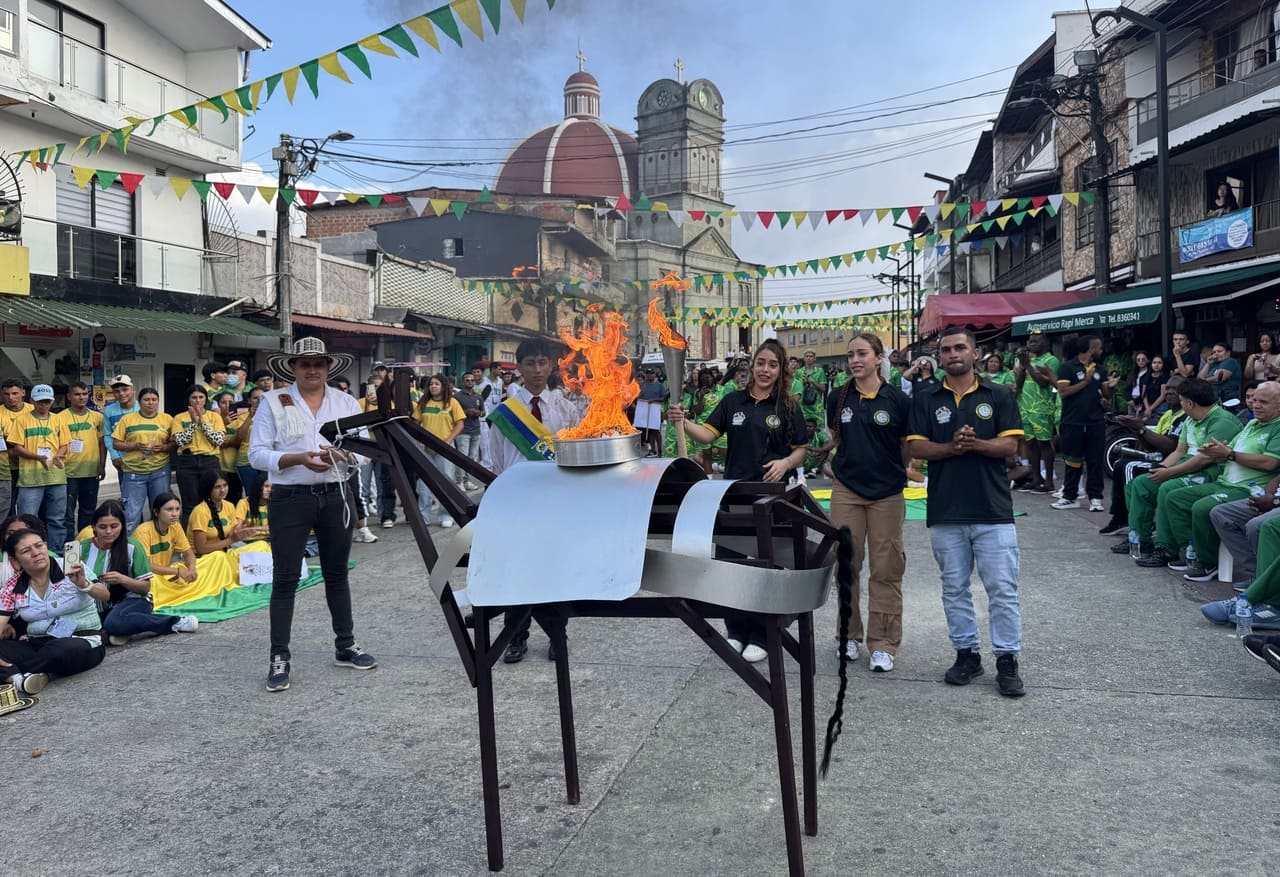
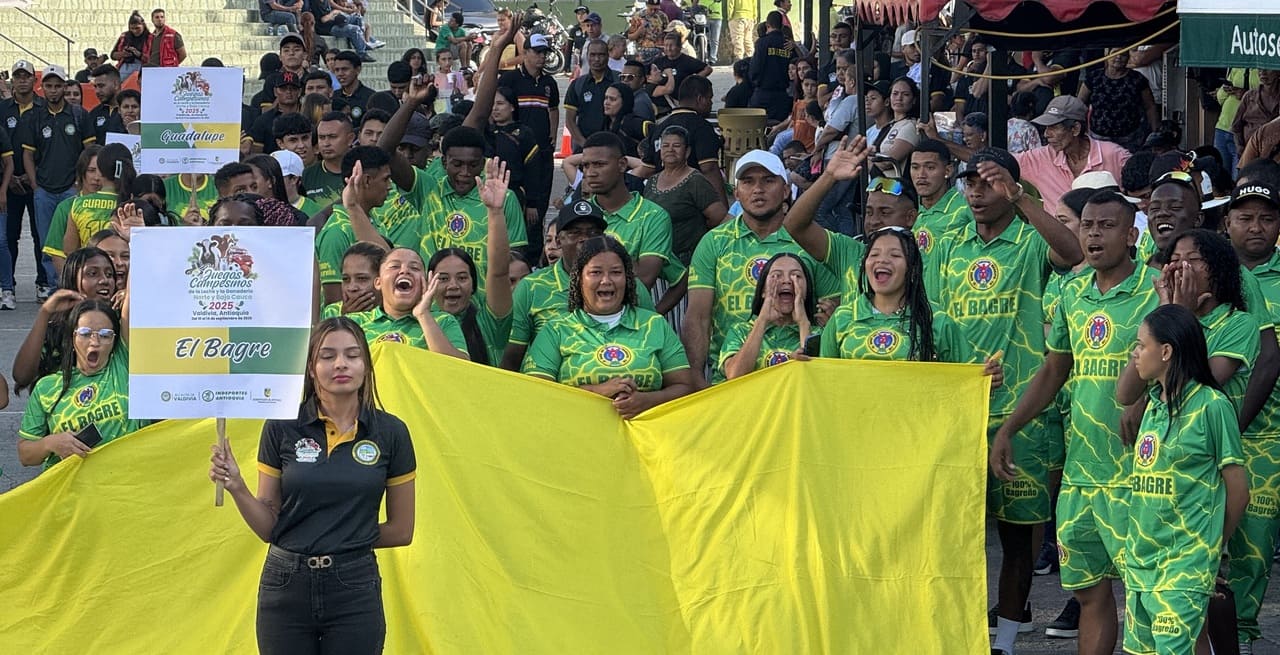
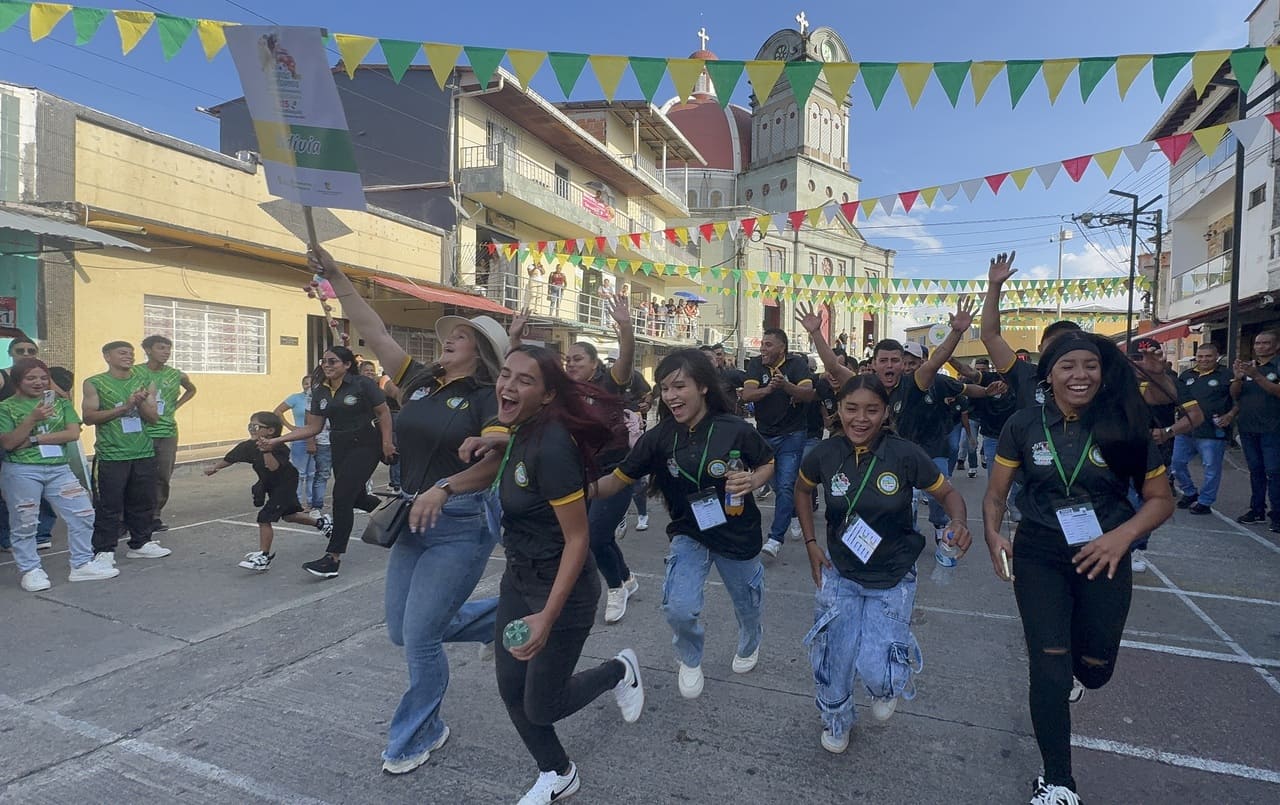
On Wednesday, September 10, 2025, shortly after three in the afternoon, the main park was filled with an unusual vibrancy. A parade set off from the La Variante sector and arrived at the park: 518 rural athletes from thirteen municipalities, wearing jerseys bearing the names of Angostura, Briceño, Cáceres, Campamento, El Bagre, Entrerríos, Gómez Plata, Guadalupe, Ituango, San Pedro de los Milagros, Santa Rosa de Osos, Yarumal, and Valdivia, the host municipality, marched between a mule and an ox—symbols of rural work in these two subregions—municipal and departmental dignitaries, referees, dance troupes, and flags representing rural life.
During the following days, five disciplines awaited them, showcased in both the women’s and men’s categories: athletics adorned the streets of the municipality and the Villa Alba residential area; basketball and futsal ignited the municipal coliseum; mixed volleyball found its rhythm between the auxiliary court and the coliseum; and soccer took over the Cachirimé field in the Puerto Valdivia district. All of this unfolded to the persistent murmur of the Andean mountains, whose music enveloped everything. As local athletes Aron Patiño, Gisela Restrepo, and Antoni Giménez carried the torch, «Canta Campesino» played, a song that the Conjunto Cerro Bravo from Fredonia was promoting on social media at the time. Applause echoed among the buildings.
The Olympic cauldron arrived on the stage atop an iron mule, led by the mayor of the municipality, Carlos Danober Molina Betancur—an agricultural engineer and farmer who always wears a hat, never removing it even when interviewed at the Telemedellín studios. Davison Dávila, a volleyball player from Valdivia, recited the athletes’ oath. Yolanda Ramírez, a volleyball referee, took the oath of office. And then the flame was lit on that metal sculpture, and with it, a new chapter opened in the recent history of this region.
An unlikely interlude, given the context: just weeks earlier, near the road where the athletes were marching, the Army had deactivated explosives left by the ELN. In May, 215 people—92 families—had been displaced by fighting between the Clan del Golfo and the ELN-FARC dissident alliance (Infobae, 2025). In June, a policewoman had been killed in an attack on the police station. Retired General Luis Eduardo Martínez, Antioquia’s Secretary of Security, had commented in a media outlet: “There are not enough security forces to confront the violence in Valdivia” (Caracol Radio, August 1, 2025). The municipality registers a multidimensional poverty index of 81% according to the most recent Municipal Multidimensional Poverty Measure from Census Source (DANE, 2021), built from the 2018 National Population and Housing Census, compared to a national average of 11.5% (DANE, 2024).
This essay analyzes how this sporting event functioned as an emerging socio-technical alliance capable of producing territorial mediation within a context of active armed conflict and structural inequality. The central thesis is that the Valdivia Peasant Games, comprised of human actors (peasant athletes, coaches, referees, communities, families, institutions, and journalists) and non-human actors (sports infrastructure, symbolic artifacts, music, and communication platforms), produced a territorial mediation that redefined space, reduced the tension of the conflict, and activated forms of peasant citizenship. However, the transformative nature of this event revealed a structural paradox: for five days, the institutional presence articulated around sport achieved what months of military operations had failed to accomplish—a calm territory where people reoccupied public space.
The analysis draws on diverse primary sources: on-site interviews with athletes and local stakeholders, official bulletins from Indeportes Antioquia, regional and national media coverage, social media posts, and direct observation. These sources are integrated with a conceptual framework that incorporates Latin American socio-technical studies (Thomas et al., 2019; Bijker, 1995), mediation theory (Martín-Barbero, 1987), and communication and power in the network society (Castells, 2009).
The bleeding runner
To reach Valdivia from Medellín, you have to travel for about three hours along a road that climbs to the northern highlands and then descends steeply to the Cauca lowlands. The landscape changes from plantations to pastures, from mist to a humid heat that clings to the skin. The road is good, but every curve could conceal a military checkpoint or an impromptu roadblock. In 2025, at the location known as La Paulina alone, the ELN carried out twelve terrorist attacks (Caracol Radio, 2025): gas cylinder bombs, ambushes, and attacks on public buses.
The municipal economy relies on cattle ranching and dairy farming, agriculture (cassava, cacao, sugarcane, plantain, and corn), artisanal mining, and fishing. And coca: according to the Ombudsman’s Office, in its Early Warning Report No. 045-2020, the municipality had 2,360 hectares of coca crops in 2019, a figure that subsequent reports from Alerta Paisa raise to 4,726 hectares, making it the municipality with the largest cultivated area in the region.
In Valdivia, three illegal armed groups converge: the ELN, through its Compañero Tomás front and its Héroes y Mártires de Tarazá structure ; the Clan del Golfo; and FARC dissidents. El Colombiano (August 6, 2025) lists it among the eleven active conflict zones identified by the Antioquia Police. Homicide figures show an upward trend: Valdivia went from 12 in 2023 to 19 in 2024 (El Colombiano, November 24, 2024). But the regional picture is even more severe: in the Bajo Cauca region, five out of six municipalities doubled their homicide rates. Caucasia went from 38 to 65, Cáceres from 15 to 32, El Bagre from 13 to 28, and Tarazá from 12 to 24.
The months leading up to the games brought the worst of the violence. In May 2025, clashes between the Clan del Golfo and the ELN-dissident alliance led to the forced displacement of 92 families, some 215 people (Infobae, May 16, 2025). Mayor Molina Betancur made an urgent appeal to the National Government: “The threat to the civilian population is ever-present, and we want to prevent any tragic events” (Infobae, 2025). The Victims Unit delivered 5.5 tons of humanitarian aid to the displaced families who were being sheltered in the town’s coliseum (Alerta Paisa, June 2025).
The same coliseum that, weeks later, would host the athletes of the Rural Games. The infrastructure that went from humanitarian shelter to sports venue encapsulates, in its very materiality, all the tension that permeates this territory. In socio-technical terms, this transition reveals what Thomas (2008) describes as a process of socio-technical adaptation: the same structure—a municipal coliseum—is reinterpreted by different social groups according to the circumstances, transforming from a humanitarian emergency device into a space for sporting and community gatherings. The physical structure doesn’t change; what changes are the people who inhabit it, the meanings they attribute to it, and the practices that unfold within it.
The socio-technical as a lens
Understanding what happened in Valdivia requires a conceptual framework that does not separate the social from the material, the institutional from the symbolic, and the technological from the cultural. The socio-technical approach, developed in Latin America by Hernán Thomas, Lucas Becerra, Paula Juárez, and their collaborators based on the constructivist traditions of Bijker (1995) and actor-network theory, offers such tools. As Thomas, Becerra, and Bidinost (2019) point out, all technology is a social construct, and all social constructs are technological. The a priori distinctions between “the technological,” “the social,” and “the economic” dissolve in favor of an integrated perspective that speaks of “the socio-technical” (Thomas, 2008).
The concept of socio-technical alliance is central. Thomas, Becerra, and Bidinost (2019) define it as an analytical reconstruction of a coalition of heterogeneous elements involved in the process of constructing the functioning or non-functioning of a technology. This notion allows us to consider the Peasant Sports Games not as an isolated event, but as a dynamic reconfiguration of actors, artifacts, institutions, and infrastructures that co-construct a specific function: territorial mediation in a context of conflict. For his part, Marín-Marín (2025) mentions that technology is understood here in its broadest sense: artifactual technology (sports venues, cauldron, and infrastructure), process technology (game logistics, food service system, and municipal agreements), and organizational technology (inter-institutional articulation, communication management, and coordination networks).
Jesús Martín-Barbero (1987) shifted the analysis from media to social mediations, proposing that communication is a space where discourses, identities, and power relations are articulated. Manuel Castells (2009) complements this perspective by arguing that “to communicate is to share meanings through the exchange of information” (p. 87), and that the convergence of the internet and wireless communications has generated horizontal networks that connect the local and the global. Applied to Valdivia, these frameworks allow us to understand how press releases, Instagram and Facebook posts, audiovisual coverage, and radio stations function as agents in a communication network that redefines the territory: where regional and national media saw violence, the Indeportes Antioquia Rural Sports Games projected celebration, identity, and community.
In a previous work (Marín-Marín, 2025), drawing on Ladrón de Guevara (2023), a key distinction for this analysis was proposed: the difference between public communication and institutional communication. The former seeks to strengthen access to information, transparency, and participatory democracy. The latter focuses on image and reputation management. As Ladrón de Guevara (2020) states, public communication should be understood as the possibility of fostering socialization among citizens, allowing them to be heard. Following Carlos Matus’s (1996) Situational Strategic Planning (SSP), communication should be designed as a dynamic process in which interaction with the community and analysis of contextual conditions allow for continuous adjustments to strategies. This tension between public and institutional communication will be a constant throughout the case analysis.
This exploration wasn’t limited to documentary sources or interviews. Valdivia also revealed itself through the bodies in the midst of play, the restrained solemnity of a medal ceremony, the overflowing joy of those who climb the podium to claim their trophy, and the streets transformed into a festive stage. These moments demanded a different instrument. The camera then functioned as an extension of observation: to preserve what words cannot fully name. The images accompanying this essay are, in that sense, field notes that document, with the same analytical intent as the rest of the text, the embodied and territorial dimension of these Rural Sports Games.
Community-based sport, enshrined in Colombian legislation, differs from high-performance sport in that its purpose is not competition but social cohesion and community building. The Political Constitution of Colombia (1991), in Article 52, recognizes access to sport as a fundamental right. Law 181 of 1995 establishes that public policies must guarantee equitable access. And the UNESCO International Charter of Physical Education and Sport (2015) emphasizes inclusion as a guiding principle. As Medina-Pérez (2013) indicates, if sport is to contribute to civic education, its communication cannot be limited to disseminating achievements, but must be built through shared narratives that transcend competition.
The competing bodies
At the heart of the socio-technical alliance that shaped the Peasant Sports Games are not institutions or infrastructure, but bodies. Five hundred and eighteen peasant bodies who, to reach Valdivia, had to ask for permission from their jobs, arrange childcare, travel along roads patrolled by armed actors, and carry with them the representation of their municipalities.
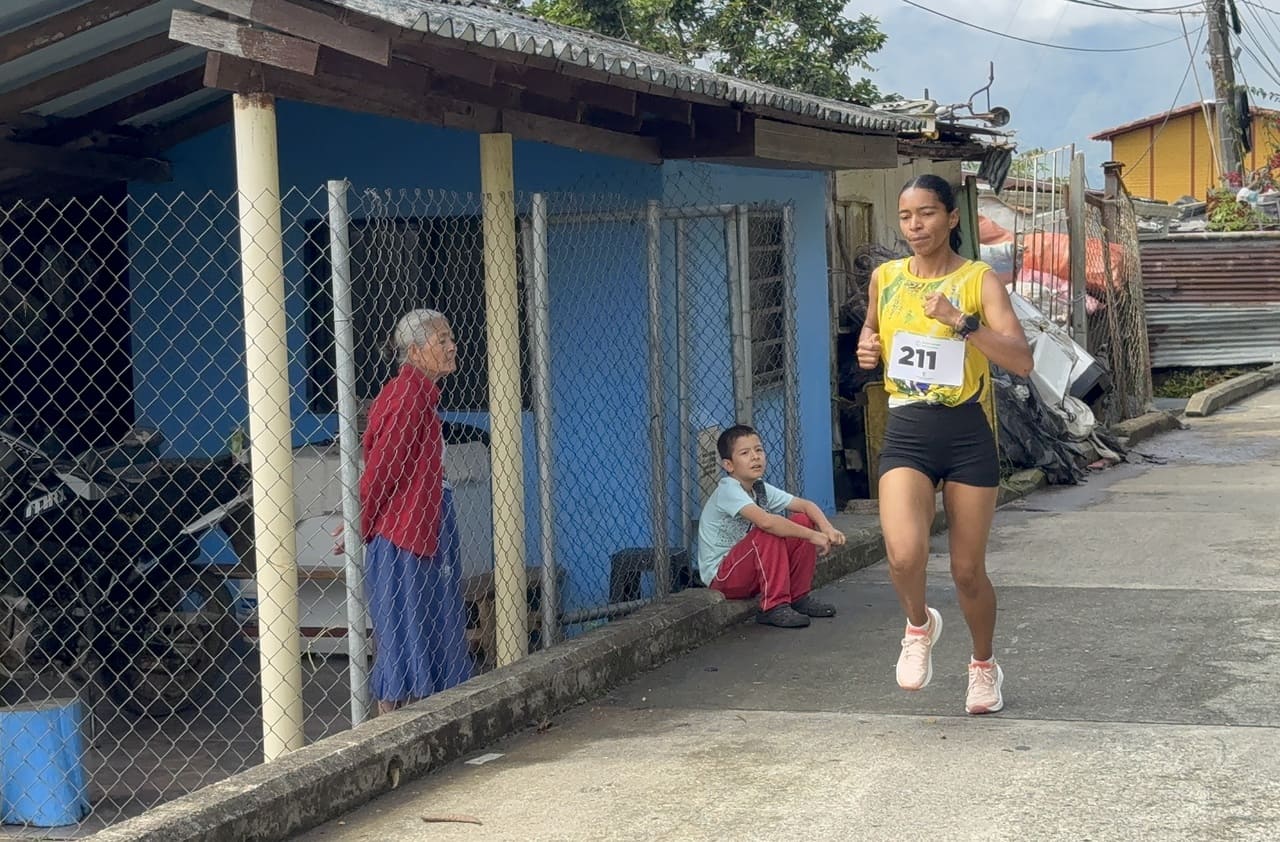
Elizabeth Espinosa Patiño has long legs and a way of speaking that blends shyness with a calm firmness. She’s from Santa Rosa de Osos, from the El Sabanazo hamlet—»a very pretty hamlet, near the town, about 40 minutes away,» she says. She’s a vendor. She’s the mother of Violeta, a 14-year-old girl who skates. And she’s a long-distance runner. She’s been running for nine years, although she’d never done so competitively until these games. In Valdivia, she participated in the 800, 1,500, and 5,000 meters, and won gold in all three events. When I asked her how she feels when she runs, she answered without hesitation: «Athletics is in my blood; I feel free, I enjoy it, I feel at peace.» Then she added something I haven’t been able to forget: «It’s a challenge to be a mother, a worker, and an athlete, but when you do something with love, you always find the time» (my own interview, September 2025).
Elizabeth’s case embodies what Law 181 of 1995 establishes as equity in access to sports, but with a depth that the regulations fail to capture. She is a peasant woman who competes in a besieged territory, who runs through the streets of a town where the media usually only go to cover violence, and who, upon crossing the finish line, demonstrates to her daughter and her community that another story is possible. “My dream is to become a good athlete, to greatly improve my times and to be a very good long-distance runner,” she told me after the race, with the serenity of someone who knows that dreaming is already an act of resistance. In that statement lies something that transcends sports: the legacy that a mother, an athlete, gives to her daughter upon crossing the finish line in a war-torn territory.
Steicy Escobar Avendaño arrived in Valdivia with her son and her laptop. Originally from San Pedro de los Milagros, she has played futsal for nine years and had paused her competitions to become a mother. She asked her boss for permission, but continued working between matches and caring for her son, who accompanies her on the court. “It’s not an impediment to doing what you love,” she told Redenorte (September 2025). That image—a mother who works, competes, and coaches simultaneously, in a town in northern Antioquia—speaks volumes about gender equality in rural contexts, far more than any report.
Juan David Guerra López, a volleyball player from El Bagre, also had to request time off from work. “I’ve been waiting for these games for a long time so I could participate,” he told Redenorte (September 2025). And 16-year-old Yonier Grisales Tamayo came from Guadalupe after trading his soccer goalkeeper gloves for a volleyball. “Being here fills me with pride. Sports give me optimism, friendship, and joy,” he told me when I interviewed him. He dreams of studying telecommunications engineering at the University of Antioquia. With every serve and every spike, Yonier plays for his people and for a future he is building with discipline and passion from a town that rarely makes the news.
These testimonies are not anecdotal. They constitute the primary sources of an analysis that, from a socio-technical perspective, understands athletes as central actors in an alliance that would not function without their bodies, their decisions, and their sacrifices. It is they—not the institutions—who set the territorial mediation mechanism in motion. The institutions provide the infrastructure, the funding, the organization, the media, and the visibility. But it is the 518 peasant bodies that make the alliance work.
The rules of the fair game
Alongside the athletes, the referees in Valdivia played a role that went beyond the rules. Yolanda Ramírez, who officiated the opening ceremony, and the entire officiating team acted as mediators of legitimate order: they ensured compliance with rules agreed upon and respected collectively. In a territory where “rules” are imposed by armed actors through checkpoints, threats, and restrictions on movement, the figure of the referee restores the possibility of a consensual order, of fair play accepted by all. The whistle is not just a sporting instrument: it is a symbol that embodies the idea that there are rules that cannot be imposed by force.
And then there was the music. From the opening parade to the closing ceremony, the traditional folk music—the strings, songs, and rhythms that define the inhabitants of the Antioquian Andes—served as a tool for cultural mediation. It wasn’t merely a backdrop but an active participant, in the sense of Latour (2008): it shaped the emotional climate of the event, activated collective memory, reinforced a sense of belonging, and created a shared soundscape where athletes and host communities recognized themselves as part of the same culture. Martín-Barbero (1987) anticipated this when he wrote that popular cultural practices are spaces of mediation where collective identities and meanings are articulated.
The iron mule that carried the Olympic cauldron is the most powerful symbolic artifact of the entire event. In Bijker’s terms (1995), it functions as an artifact with interpretive flexibility: for the organizers, it was a tribute to rural life. For the athletes, a reflection of their peasant identity. For the media, an image that encapsulated the entire narrative. “We wanted to include a mule and a cow, which are symbols of these two subregions, the North and the Lower Cauca, where this Andean zone blends with the savannas that begin toward the Colombian Caribbean,” explained Mayor Molina Betancur (own interview, September 2025).
The sports infrastructure that made the event possible included the coliseum and its auxiliary court, the streets, and the Cachirimé court in Puerto Valdivia. Educational facilities were converted into accommodations for athletes, with logistics that included food, transportation, officiating, and medical care for five days. The organization relied on the collaboration between Indeportes Antioquia (funding, technical coordination, and communications), the Valdivia Mayor’s Office (local logistics), and the public security forces. The 2025 Rural Sports Games, as a whole, mobilized an investment of approximately 2.5 billion pesos (Antioquia Government, 2025).
According to the Antioquia Sports Observatory (2025), 4,236 rural athletes participated in the six subregional competitions that year: 2,672 men and 1,564 women. Ferney Cardona Echeverri, Deputy Manager of Sports Promotion and Development at Antioquia Sports Institute, emphasized the strategy of contracting directly with municipalities: “It revitalizes transportation, restaurants, gastronomy, hotel infrastructure, and the informal economy, which sometimes goes unnoticed but is fundamental” (Primer Plano, issue 207, August 2025). This collaboration constitutes what Thomas (2012) would call a Social Technological System: a heterogeneous structure oriented toward generating dynamics of social inclusion.
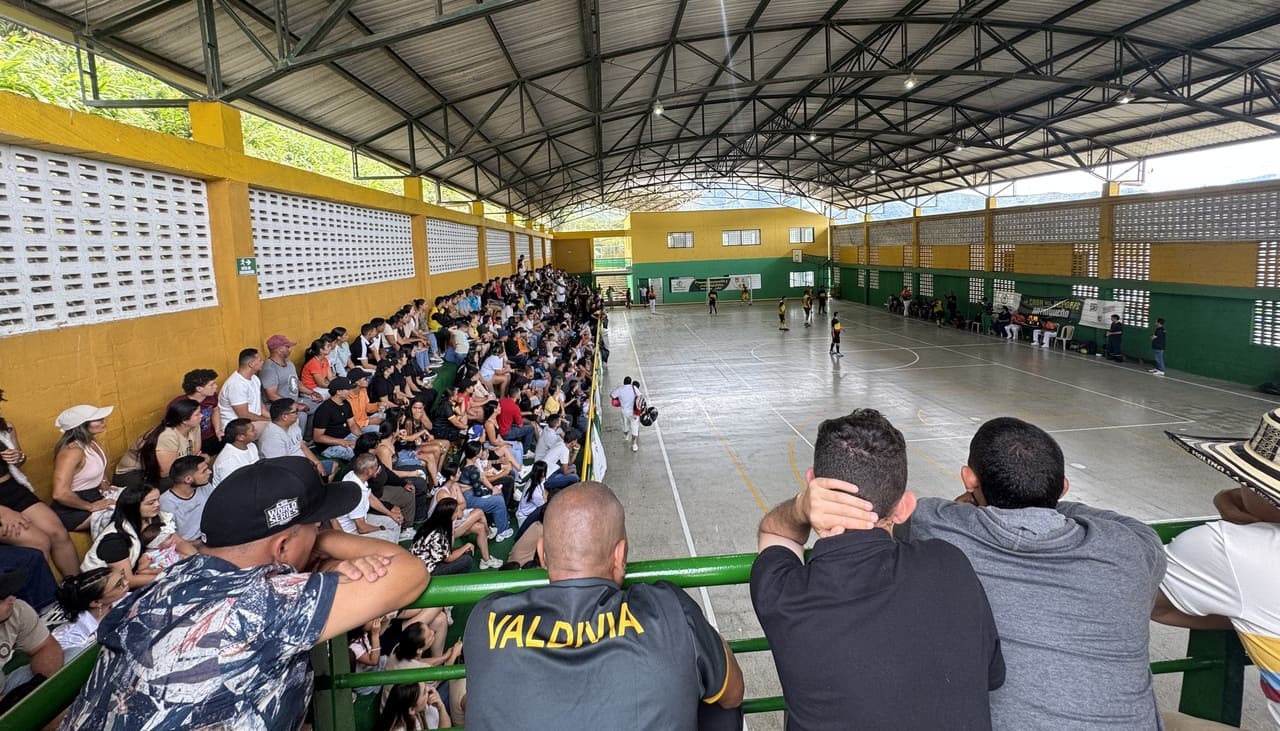
In Valdivia, Mayor Molina Betancur calculated the economic impact in concrete terms: “These 500 athletes, or a few more who came, each spent at least 40,000 or 50,000 pesos, and that multiplied by 500 people adds up to 25 or 30 million pesos that also contribute to strengthening the local economy” (own interview, September 2025). Grocery stores, produce markets, hotels, and restaurants provided food and lodging for athletes, judges, and support staff during the five days of competition. A modest figure in macroeconomic terms, but significant for a local economy battered by conflict. “Through sports and healthy lifestyle habits, territory is created and peace is generated for a population that so desperately needs it,” Cardona Echeverri had said when presenting the start of these athletic games (Antioquia Government, 2025).
Puerto Valdivia: football where there was once war
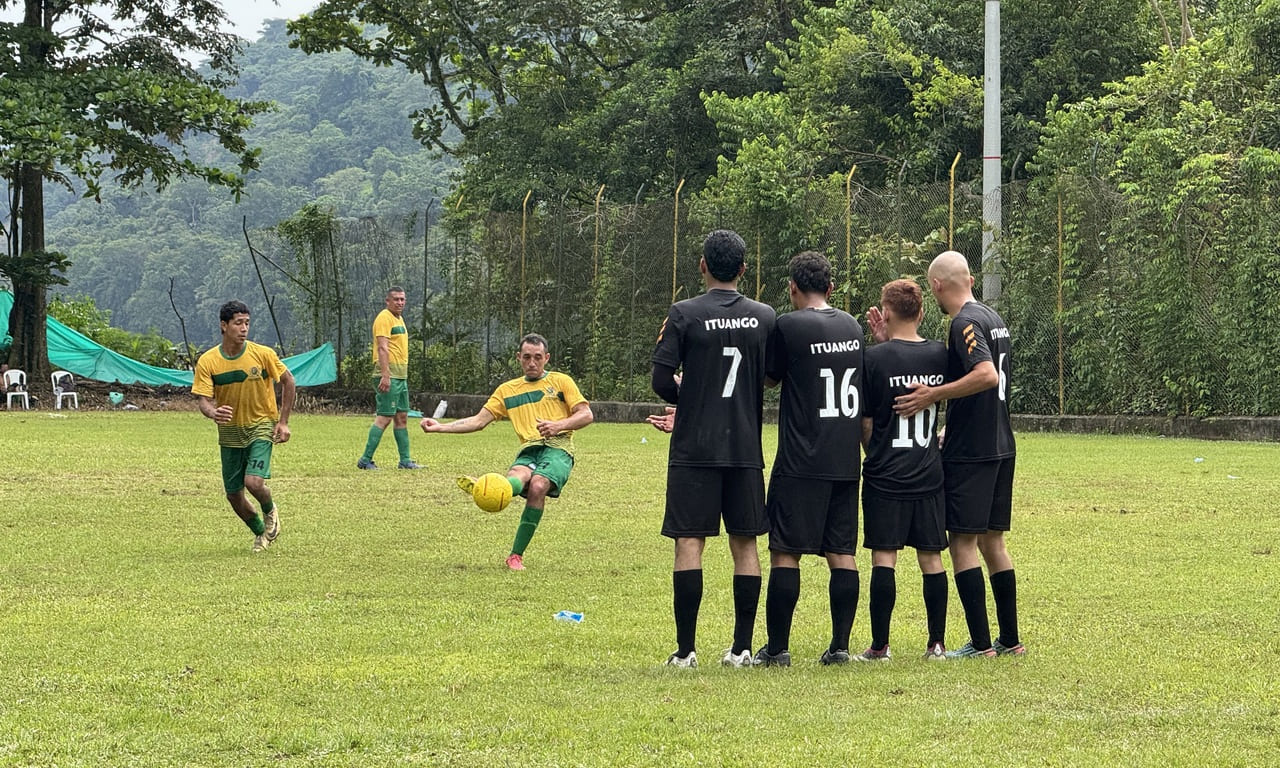
The most telling detail of the entire sporting event lies not in the statistics but in the location: the soccer matches were played on the Cachirimé field, located in the township of Puerto Valdivia, which had been the scene of violence just days before. El Colombiano (September 12, 2025) noted this as a “sign that the atmosphere has eased somewhat.” The “tense calm” that is common in the area, according to the newspaper, briefly transformed into something resembling normality.
There, on a natural grass field damaged by heavy nighttime rains, Johiner Rivera, number seven for Angostura, executed a free kick that nestled inside the left post, becoming the eighth goal in an 8-0 victory against Ituango (Indeportes Antioquia, September 12, 2025). At that same venue, El Bagre was crowned champion in both men’s (5-1 over Cáceres in the final) and women’s (9-0 over Campamento) soccer, with the women competing fiercely. The athletes from El Bagre—the same municipality that saw its homicides double in 2024, from 13 to 28—dominated the fields with a vigor that suggested the pent-up energy of violence was finally being channeled in the right direction.
Athletics also provided memorable days. Santa Rosa de Osos shone with five gold medals, four of them thanks to Elizabeth Espinosa and Estiven Arcila. El Bagre added several medals. The 1,500 meters, the 800 meters, the 400 meters, the long jump, and the shot put: each event was a small celebration of rural bodies achieving extraordinary feats in a territory that is usually hard-hit. Mixed volleyball, with Liliany Jaraba Navarro serving from the baseline to give Cáceres the title, concluded with the final against El Bagre. Futsal saw Valdivia crowned men’s champion, defending the title won the previous year in Toledo. Nelson Augusto Hernández Díaz, an employee of Indeportes Antioquia and advisor for the two subregions, had said it in his opening speech: “During these days, we will not only see goals, baskets or points, we will also witness stories of brotherhood, respect and joy that will remain in the memory of Valdivia” (Indeportes Antioquia, September 10, 2025).
Communication as an agent
Mayor Molina Betancur—the same man in the hat who led the iron mule to the park—expressed it lucidly: “Many media outlets were surprised: ‘Come on, but if 15 or 20 days ago there was some not-so-good news in Valdivia, how come now they’re going to hold rural games?’” He added: “That was precisely the point, to talk a little about something else” (own interview, September 2025). A journalist from a television channel stated on air: “Unfortunately, we almost always mention Valdivia to talk about news that isn’t so positive, but many good things are also happening there” (Telemedellín, September 10, 2025). The media shift was verifiable: El Colombiano ran the headline “’Truce’ to the conflict in Valdivia.” Teleantioquia, Redenorte, Caracol Radio, Todelar, and various independent and community media outlets covered the sporting event. The athletes also shared content on their social media.
Indeportes Antioquia produced six press releases over the five days, featuring photographs and testimonials. Instagram posts from @indeportesantioquia and @alcaldiavaldivia, as well as their Facebook accounts, generated visual content that circulated on social media—the Mayor’s Office streamed both the opening ceremony and the matches played in the coliseum . The audiovisual news program Primer Plano (episode 211, September 13) included a report on Valdivia, as did the radio news programs La Voz de Indeportes Antioquia and La Voz del Deporte Antioqueño. From Castells’ (2009) perspective, these multiple entry points to the decentralized communication network functioned as agents that, for five days, displaced the narrative of violence. Public communication was not an accessory to the sporting event but a strategic component of the socio-technical alliance.
But the term “truce,” in quotation marks, as used by El Colombiano, reveals an ambiguity that deserves analysis. There was no formal agreement between the armed actors. What occurred was a confluence: the massive presence of communities from thirteen municipalities, media coverage, and a situation that the mayor described as a prior “notable improvement” in security. The “truce” was, perhaps, less a decision by the armed groups than an emergent effect of the socio-technical alliance: when nearly 500 people occupy public space, when cameras broadcast from a stigmatized territory, when the coliseum fills with applause instead of displaced people, and the territory is momentarily reconfigured.
And then it all falls apart. In December 2025, barely three months after the games, the ELN staged an armed strike, burning a public bus on the same Medellín-Caribbean Coast highway that runs through Valdivia. The Army reinforced security in the La Paulina area and recommended traveling in escorted convoys (El Tiempo, December 15, 2025). The dynamics of conflict returned. The question this cycle leaves us with is not whether rural sports function as a means of territorial mediation—the Valdivia Rural Games demonstrated that they do—but why the State fails to sustain over time what proved possible for just one week.
It is important to recall Ladrón de Guevara’s (2023) warning about a persistent tension: the confusion between public communication—oriented toward the citizenry—and institutional communication—oriented toward the entity’s image. In Valdivia, this tension manifested itself in the coexistence of narratives: on the one hand, athletes’ testimonials and coverage by independent media constituted a genuine exercise in public communication; on the other, press releases also fulfilled institutional positioning functions. The line between the two is not always clear, and they can coexist. Their proper management is fundamental for sports communication to be a tool at the service of the citizenry and not for self-promotion.
What Valdivia sowed
The 2025 Rural Dairy and Livestock Games demonstrated something that security reports rarely mention: that in a territory besieged by three illegal armed groups, with a multidimensional poverty index of 81% (DANE, 2021), where 215 people had been displaced just weeks before, it is possible to bring together 518 athletes from thirteen municipalities to compete peacefully for five days. That soccer matches can be played in Puerto Valdivia, the same district that was the scene of recent clashes. That a mother selling goods in Santa Rosa de Osos can run freely through the streets of a town that the media only mentions when covering conflict. That a 16-year-old from Guadalupe can dream of university while spiking a volleyball. That lively party music can fill the streets where only war reports were heard before. The iron mule that carried the brazier at the beginning sums it all up: it is an artifact made of work and peasant history, and on its back was sustained, for five days, the concrete possibility of another story.
From this perspective, the Peasant Sports Games operated as an emerging socio-technical alliance in which human and non-human actors aligned and coordinated to produce a specific function: territorial mediation. This alliance redefined public space, activated the local economy, and generated visible and recognized forms of peasant citizenship. Public communication, in this framework, was not merely an accompaniment but a central agent that transformed the narrative of the territory. Peasant women like Elizabeth Espinosa and Steicy Escobar embodied the transformative power of sport with an intensity that no institutional discourse could match: competing, working, finding time to care for their children, and representing their municipalities, in a context of active armed conflict, is an act of public agency that deserves to be recognized as such.
The event revealed the power of rural sports as a transformative force. Not a palliative, not a substitute for structural policies, but a concrete demonstration that when institutions, communities, public communication, and infrastructure are brought together, conditions for territorial peace can be generated. The structural paradox, however, persists: this collaboration dismantled as soon as the games ended. If a week of rural sports can achieve what months of military operations cannot, perhaps the problem is not a lack of resources but a lack of will to use them sustainably.
El Bagre, the municipality that saw the largest increase in homicides in 2024, was also the one that achieved the greatest sporting success. This paradox is not mere rhetoric: the human potential for peacebuilding exists precisely where it is most needed. In Valdivia, as stated in the latest press release from Indeportes Antioquia, the conviction was sown that “rural sports are much more than competition: they are identity, unity, and a future for rural Antioquia” (Indeportes Antioquia, September 14, 2025).
References
- Ballesteros-Herencia, CA (2021). Proposal for an integrated communication plan in sports management. Ibero-American Journal of Sciences of Physical Activity and Sport, 10 (3), 160-177.
- Bijker, W. (1995). Of Bicycles, Bakelites and Bulbs. Toward a Theory of Sociotechnical Change. Cambridge: The MIT Press.
- Campillo, C. (2011). Public communication and municipal administration. A proposed structural model. Thinking about Advertising, 4 (1), 45-62.
- Caracol Radio. (August 1, 2025). “There are not enough law enforcement officers to confront the violence in Valdivia”: Secretary of Security. 6AM Hoy por Hoy. https://caracol.com.co/
- Castells, M. (2009). Communication and Power. Madrid: Alianza Editores.
- Congress of Colombia. (1995). Law 181 of 1995, which establishes provisions for the promotion of sport, recreation, leisure time and physical education.
- Political Constitution of Colombia (1991). Article 5. Official Gazette of the 1991 Constituent Assembly No. 85. http://www.secretariasenado.gov.co/index.php/constitucion-politica
- DANE. (2018). National Population and Housing Census 2018. Municipal Results.
- DANE. (2021). Municipal Multidimensional Poverty Measure from the 2018 Census . National Administrative Department of Statistics. https://www.dane.gov.co/index.php/estadisticas-por-tema/pobreza-y-condiciones-de-vida/pobreza-y-desigualdad/medida-de-pobreza-multidimensional-de-fuente-censal
- DANE. (2024). Multidimensional poverty in Colombia, year 2024. Technical Bulletin.
- DANE. (2025). Municipal population projections 2018-2035, based on the CNPV 2018.
- Office of the Ombudsman. (2020). Early Warning No. 045-2020. Institutional Capacity Strengthening Program. https://alertastempranas.defensoria.gov.co/alerta/Details/91777
- El Colombiano. (September 12, 2025). “Truce” in the conflict in Valdivia, in northern Antioquia, due to the holding of rural games. https://www.elcolombiano.com/antioquia/conflicto-armado-deporte-DK29101354
- El Colombiano. (November 24, 2024). Homicides skyrocketed in 13 municipalities of Antioquia in 2024. https://www.elcolombiano.com/antioquia/municipios-de-antioquia-donde-aumentaron-los-homicidios-en-2024-AP25916666
- El Colombiano. (August 6, 2025). The 11 disputes between armed groups in the subregions of Antioquia. https://www.elcolombiano.com/antioquia/zonas-activas-de-conflicto-en-antioquia-GP28504332
- El Tiempo. (December 15, 2025). ELN armed strike in Antioquia: explosion in Salgar, bus burned in Valdivia, and flags displayed in Copacabana, Guarne, and Caldas. https://www.eltiempo.com/colombia/medellin/paro-armado-del-eln-en-colombia-en-antioquia-subversivos-quemaron-un-bus-en-valdivia-ye-instalaron-tres-banderas-alusivas-en-la-region-3516892
- Antioquia Government. (June 20, 2025). The Antioquia Government begins the subregional competitions of the 2025 Rural Sports Games. https://antioquia.gov.co/index.php/antioquiacuenta/la-gobernacion-de-antioquia-inicia-las-justas-subregionales-de-los-juegos-deportivos-campesinos-2025
- Indeportes Antioquia. (September 10-14, 2025). Press Releases No. 1-6, Rural Sports Games for Dairy and Livestock, Valdivia. https://indeportesantioquia.gov.co/boletin-juegos-campesinos-2025/
- Indeportes Antioquia. (2025). Sports Observatory – Rural Sports Games. Retrieved from https://indeportesantioquia.gov.co/observatorio-juegos-deportivos-campesinos/
- Infobae. (May 16, 2025). Alliance between guerrillas against the Gulf Clan in Antioquia: 215 people displaced in Valdivia by the fighting. https://www.infobae.com/colombia/2025/05/16/alianza-entre-guerrillas-contra-el-clan-del-golfo-en-antioquia-215-personas-fueron-desplazadas-en-valdivia-por-los-combates/
- Latour, B. (2008). Reassembling the Social: An Introduction to Actor-Network Theory. Buenos Aires: Manantial.
- Ladrón de Guevara, LA (2020). What is public communication? Ibero-American Union of Municipalities.
- Ladrón de Guevara, LA (2023). Public communication as a strategic tool for local development. Ibero-American Journal of Local Government , 23.
- Marín-Marín, AE (2025). Public communication of sport: strategies for active citizenship. Anesma. https://www.anesma.com/comunicacion-publica-del-deporte-estrategias-para-una-ciudadania-activa/
- Martín-Barbero, J. (1987). From Media to Mediations: Communication, Culture, and Hegemony. Mexico: Editorial Gustavo Gili. https://revista.cigob.net/23-junio-2023/articulos/la-comunicacion-publica-como-herramienta-estrategica-para-el-desarrollo-local-NJI7/
- Matus, C. (1996). PES Method (Situational Strategic Planning). La Paz: Center for Studies of the Bolivarian Reality.
- Medina-Pérez, G. (2013). Sport and political communication: paths or shortcuts to foster their encounter? Political Studies , 42, 157-179.
- Thomas, H. (2008). Closed structures vs. dynamic processes. In H. Thomas and A. Buch (eds.), Acts, actors and artifacts. Sociology of technology (pp. 217-262). Bernal: National University of Quilmes.
- Thomas, H. (2012). Technologies for social inclusion in Latin America. In H. Thomas, M. Fressoli and A. Lalouf (eds.), Acts, actors and artifacts. Bernal: National University of Quilmes.
- Thomas, H., Becerra, L. and Bidinost, A. (2019). How do technologies work? Socio-technical alliances and processes of constructing functioning in historical analysis. Open Past , (10), 127-158.
- Thomas, H. and Juárez, P. (2018). Public technologies. Political strategies for sustainable inclusive development. Bernal: National University of Quilmes.
- UNESCO. (2015). International Charter of Physical Education, Physical Activity and Sport. https://unesdoc.unesco.org/ark:/48223/pf0000235409_spa


