I was perhaps eight years old when I discovered that a voice could be an entire stadium. On my dad’s old Silver tape recorder—one of those that devoured large batteries and ninety-minute cassettes with equal speed—I recorded soccer broadcasts like someone hoarding water during rationing. I saved the shouts, the pauses, and the tense silences before the penalty kick. Above all, I saved the words: those almost impossible constructions that the commentators conjured in tenths of a second to describe what no image could fully capture.
Football commentators and the power of collective emotion
Back then, going to the stadium also meant having a radio to your ear. The game signal and the commentator’s voice arrived simultaneously. They were the ones who knew how to name beauty. Voices that moved masses with a single phrase, that transformed a wayward shot into a Greek tragedy or a goal from midfield into a collective epic. For the kid recording from his living room, they were demigods.
Later, while studying at the Universidad de Antioquia and beginning my professional involvement in that world, I understood that they were something more interesting: they were human beings. People with a microphone in their hand, an audience listening to them, and, deep inside, the same unresolved tension that all of us who love football carry. That tension—between what one feels and what one says—is the heart of everything that came after.
Experiencing football from different roles
I’ve worked in various aspects of football. After playing for a few years in tournaments in the Antioquia league—with more enthusiasm than talent, it must be said—I was on the referee’s side. Then I came to the media, with a tape recorder in hand—no longer the Silver one from my childhood, but a professional one, the kind you used to show as proof of identity before showing your press card—chasing after statements in press rooms.
And then, from within a professional team: he attended to journalists, managed their access and wrote bulletins at eleven o’clock at night after a defeat, seeking the right tone between transparency and institutional prudence.
Three different perspectives on the same phenomenon: the language of football as a symbolic battleground where words not only describe what happens, but often create it, distort it, or ignite it. From each side, I learned something different. But the most persistent lesson, the one that keeps coming back, always comes from within the media. If I were to recount everything I experienced in those corridors, it would fill many books.
Sociology of football and the construction of identities
Football has its own grammar, which sociologists and anthropologists have been trying to decipher for decades. The Frenchman Christian Bromberger described it as a ritual that condenses, in ninety minutes, the deepest tensions of a community: its fears, its hierarchies, its desires for victory, and its need for belonging.
Pablo Alabarces, from Argentina, traced how the language of football fans constructs identities that don’t fit into everyday language: insults as a shield, chants as a sign of tribal identity, offenses as a liturgy for those who recognize each other as much by what they love as by what they hate. His compatriot Eduardo Archetti went even further: football is one of the few spaces where verbal violence is not only tolerated, but ritualized, expected, and, in many cases, celebrated as a sign of authenticity.
Sports journalism versus the language of the fans
The problem isn’t that this grammar exists. The problem is when journalists adopt it as if it were their own. And worse still, when they normalize it.
Because there is an essential difference—fragile, but fundamental—between the fan shouting from the stands and the journalist speaking into a microphone, writing a column, or commentating on a screen. The fan speaks from a place of sometimes blind love, from the sting of the result, or from an identity that neither negotiates nor demands attention. The journalist, on the other hand, speaks from a position of mediation: interpreting, contextualizing, and guiding. Or at least, they should.
The microphone isn’t an extension of the t-shirt—the one that changes design every season as a marketing strategy. The commentary, the column, the thread on X, or the TikTok video: all are, or should be, instruments of public understanding. But that line, in today’s communication ecosystem, has become so porous that it’s sometimes invisible.
Digital media, algorithms, and aggressive discourse
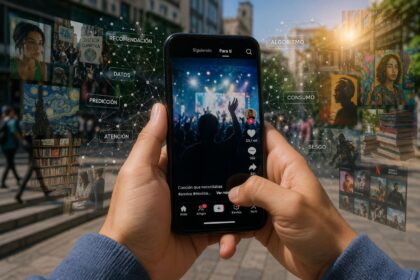
Digital platforms didn’t invent aggressive language in football. It was already there, ingrained in fan culture, in the huddles in the stands or in the broadcast booths—well, now most don’t even go to the stadium and broadcast from studios or homes. What digital media did was give it an endless stage and immediate gratification.
An inflammatory comment doesn’t just travel further than a well-argued article. It travels faster, generates more reactions, and builds community—even if that network is based on anger, not understanding. The algorithm doesn’t distinguish between legitimate outrage and gratuitous outbursts. So, everything is about interaction. And interaction, in the logic of these platforms, is the currency that matters.
The pressure of appearing like a fan in sports journalism
This affects everyone equally. From the commentator who gets carried away in the booth, to the analyst who offers their opinion on the midday panel, to the journalist who posted on social media before the game was over, or the «content creator» who provides tactical analysis with the same tone as someone hurling insults from a bar. The format changes. The temptation remains the same.
In this context, the sports journalist—regardless of their outlet or platform—faces a silent but constant pressure: to resemble the stands in order to survive. To adopt their tone, their insults, and their emotional urgency. To become, essentially, the most articulate fan in the group, not their critical interlocutor.
And that conversion doesn’t always happen in a dramatic moment. It happens slowly, like a cassette tape worn out from so much rewinding. An extra word here, an out-of-place adjective there, a live broadcast or comment where the heat got the better of the brain.
I’ve witnessed this slippage from within. I’ve seen it in storytellers who lost the thread between describing and judging. I’ve seen it in commentators who confused analysis with an unappealable verdict. I’ve seen it in journalists who forgot about contrast. And I’ve felt it myself, in moments of weariness or carelessness, when the boundary between what I thought as a journalist and what I felt as a fan thinned until it became almost transparent.
Institutional communication and media relations
When I was in charge of communications for a professional team, the relationship with the media was always a negotiation between worlds that need each other but don’t always understand one another. Journalists wanted access, information, and unfiltered truth. The institution wanted a narrative, damage control, and protection for its members. Caught in the middle, I tried to translate without betraying either side. It was a tightrope walk, and the days of defeat were the weakest link, the moment when everything could collapse.
What I learned in that role is that the institutional communicator cannot be the policeman of journalism, but neither can they be its complacent mirror. Their responsibility—often invisible, always thankless—is to guarantee conditions for journalistic practice to occur with rigor, with real access, with transparency, and with dignity for all. They are the bridge between the institution and its people.
Press accreditation is not a favor granted or a privilege bestowed: it is a working tool and a symbol of trust between the reporter and the reporter. When that trust is broken—from any side—something bigger than a protocol is fractured.
Importance of responsibility
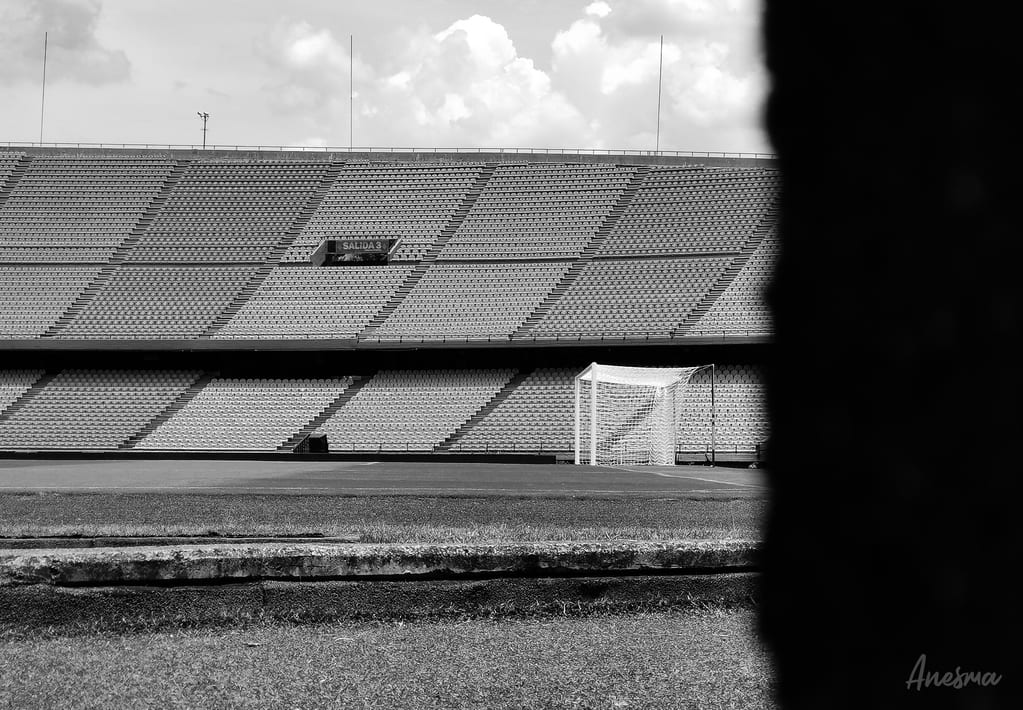
There’s a scene that keeps coming back to me when I think about all this. It was after a tough match at the Atanasio Girardot stadium, back when press conferences were held inside the locker rooms and there weren’t any of the mixed zones that now structure that ritual. A well-known journalist, with decades of experience and hard-earned authority, came out of the hallway wearing headphones and looking at his recorder. I asked him if he had recorded the coach’s statement.
He barely looked up. There was a pause. Brief, but intense.
—“It doesn’t matter what he said. What matters is what I say,” he replied.
He didn’t say it maliciously. It seemed he said it with the knowledge of someone who understands that speed won the race against rigor long ago. But that sentence encapsulated the entire problem. The entire fracture. The entire weight of a profession that sometimes forgets its purpose.
Today, that same phrase could be uttered by the commentator who offers an opinion without having watched the entire match, the analyst who constructs their narrative before listening to the protagonist, the digital journalist who publishes first and verifies later, if at all. The medium changes. Responsible journalism practices do not.
The power of storytelling in football and its social impact
Football is, among many other things, a way of narrating the world. Those of us who tell its story—from behind a microphone, a camera, a keyboard, or a cell phone screen—carry a responsibility that goes far beyond the match result. We construct narratives that people use to understand themselves. To know who won, yes, but also to know who they are, where they come from, and what they deserve.
Aggressive language, insults as a means of expression, anger turned into a method. All of this has real consequences beyond the screen, in school playgrounds, at restaurant tables, in WhatsApp groups where football is still discussed long after the referee has blown the final whistle.
The boy with the Silver tape recorder knew that narrating football was about reproducing the emotion. The adult who later learned to referee, cover matches, and manage sports communications knows that narrating football is also about choosing what world to build with each word.
That choice isn’t resolved in codes of ethics or accreditation protocols. It happens, silently and decisively, every time someone stands before their microphone, their camera, their column, or their social media and has to decide—in tenths of a second, like that narrator I used to record as a child—whether at that moment they are a journalist or a fan.